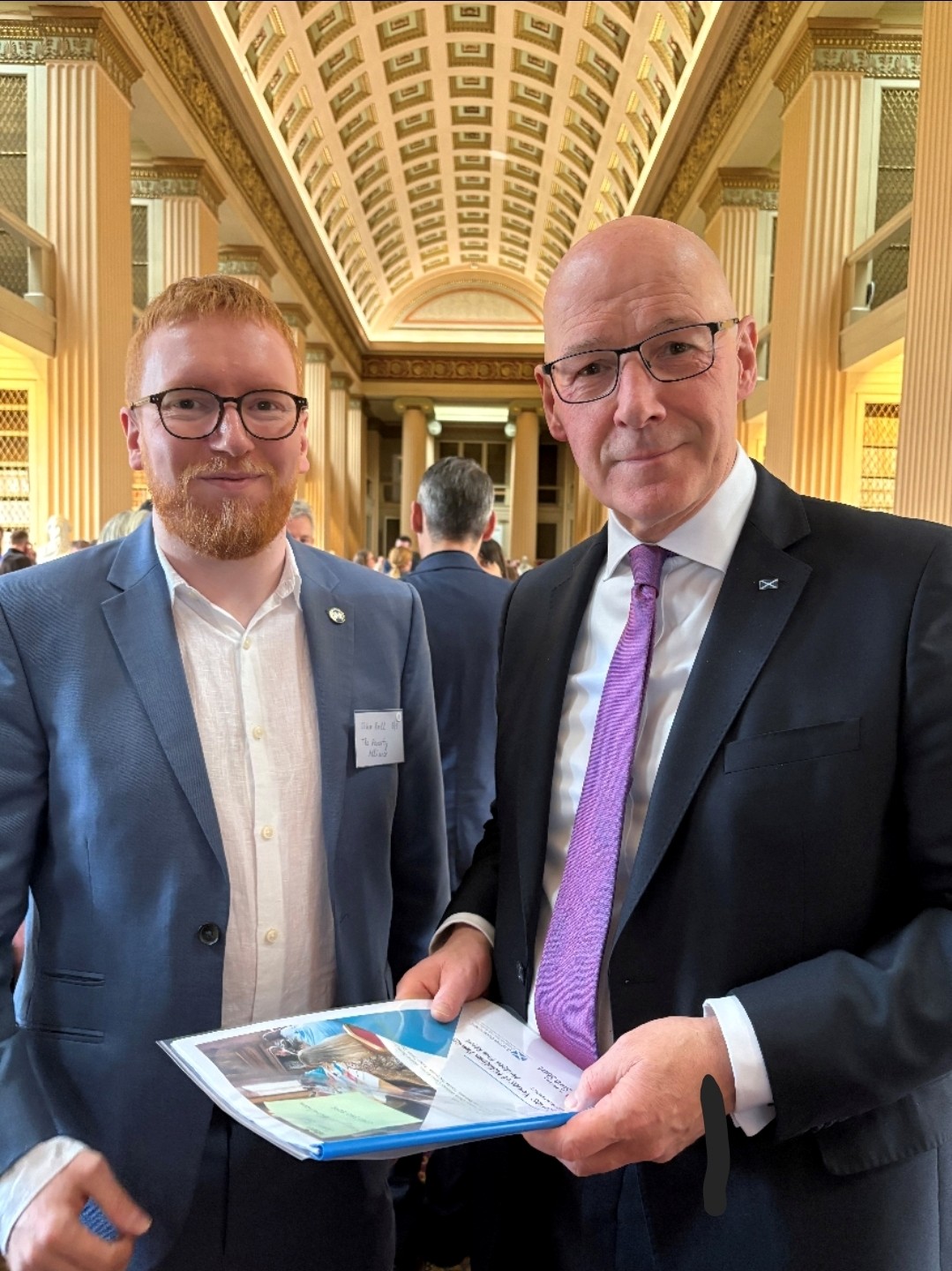
Recently I was invited to attend a Scottish Leaders Forum Event organised by the Scottish Government's Place Based Social Justice team. An opportunity I was both grateful for and, if I’m honest, a little intimidated by. The room would be full of leaders from across Scotland’s third and public sectors: senior figures, decision-makers, and long-established professionals. I couldn’t help but wonder: what could I possibly be bringing to the table?
For the past year, I’ve been working as a community researcher in Midlothian. Alongside my colleagues, and with support from the Child Poverty Practice Accelerator Fund, we set out to engage directly with families affected by poverty in our area. Through one-to-one conversations, we listened as 62 families told us what was working, what wasn’t, and what they needed from the systems around them. Our report was delivered to the Scottish Government with the hope of influencing meaningful policy reform at both the local and national level.
More recently I began working with The Poverty Alliance on the Get Heard Scotland panel where we regularly meet with an aim to shape future legislation with recommendations informed by our own lived experience.
That’s the background I brought with me. But still, stepping into a formal forum like this was, for me, a real shift.
We were welcomed by Professor John McKendrick from Glasgow Caledonian University. In a brief conversation before things kicked off, I was interested to learn from Professor McKendrick that the University already had a working relationship with the Poverty Alliance. When I asked whether they had helped guide the Alliance’s ethnographic research efforts, he gently corrected me. “No, they guided us.” That moment stuck with me. A quiet reminder of the value of humility and lived expertise.
Professor McKendrick then opened the forum and handed over to Sir Peter Mathieson, Principal of the University of Edinburgh. He spoke with passion and clarity about his belief in education as one of the most powerful tools we have in the fight against poverty. Drawing from his own lived experience, he made it clear that access to higher education should never be dependent on background or postcode. That belief, he said, underpins the many initiatives his institution is pursuing to widen participation for young people from disadvantaged communities.
Next, First Minister John Swinney addressed the room and set the tone for the day. His message was urgent but grounded. We must build reform around the resources already available to us. He spoke about the need to break free from systems that feel comfortable but deliver limited results. “Abolishing child poverty,” he told us, “is not just a priority. It’s a moral imperative.”
There was no sugar-coating the financial reality either. “We have no money,” the First Minister said, quite plainly. “Please don’t ask me for more money because I don’t have it. I’ve given you all I can.”
It was a moment that felt confrontational, but not in any way dismissive or accusatory. Instead, it made the challenge real. If we were to drive systemic change, it must come from within. From collaboration, creativity, and better use of the assets and relationships we already have. The message was clear: today was about the people in the room, leaders across sectors, starting a collective shift in culture.
After the keynote sessions, we moved into roundtable discussions led by Joe Griffin, Permanent Secretary of the Scottish Government. He echoed the First Minister’s challenge and pushed it even further.
“What can you do?” he asked each of us at the table. Not as representatives of our organisations, but as individuals in positions of influence. Some of us offered suggestions, things we’d like to see happen, goals we believed in. But Joe pushed us harder. Those ideas were worthwhile, he said, but the real question was: What will you actually do?
It was an uncomfortable but necessary question. And, to be honest, one we struggled to answer in the moment. Only later that evening, reflecting on it at home, did I realise that we might have needed to change tack. It occurred to me that a better question to ask ourselves might have been: What are the obstacles preventing us from facilitating this change, and how can we come together to remove them?
Hindsight, as ever, is 20/20.
For those interested, Civil Service World later published an article that captured some of the ideas raised in that discussion with Joe Griffin:
**************************
The afternoon sessions showcased examples of local success. One that stood out was the work of the Working for Wallacetown initiative in South Ayrshire.
Through effective community planning partnerships, South Ayrshire have seen approval numbers rise and a real shift in how local people feel their needs are being met. Their success served as a concrete example of how joined-up approaches, rooted in local voices, can make a genuine difference.
Before moving into the later sessions, we paused for a moment of reflection. A young man named Martin Calder, just 17 and newly started in an apprenticeship, stood to share a poem he'd written about his experience with different services growing up. His piece, Too Many Professionals, was stunning in its clarity and pain. Here’s an excerpt:
A circle of faces, all staring in,
Each with a question, each with a spin,
They talk in words that twist and wind,
All trying to fix what they think they’ll find.
The room was still when he finished. For a few moments, no one spoke. And in that silence, his words seemed to settle into us. For me, it was one of the most powerful parts of the day.
We then heard from Professor Donna Hall OBE of Mutual Ventures, who shared a set of ten enablers for systemic collaboration in Whole Family Support. They included:
- Model Bold Collaborative Leadership
- Align Around Shared Purpose
- Shift Power to Communities and Front-Line Staff
- Fund for the Long-Term with Flexibility
- Invest in a Collaborative Culture, Not Just Structures
- Create Governance Ecosystems, Not Hierarchies
- Prioritise Emergence Over Planned Approaches
- Work in the Open to Build Collective Learning and Momentum
- Align Resources Beyond Money
- Institutionalise Collaboration Through Roles and Practices
Point 4, in particular, stood out for me. It was an interesting concept that true flexibility means accepting that some initiatives will fail, and that failure must not be the criteria we use to decide whether something had value to begin with. When we’re seeking generational change, trial and error isn’t optional. It’s essential.
During the lunch break, all attendees were kindly gifted a copy of Working Together: A Framework for Collaborating in Complexity by Dr. Christy Docherty. The book outlines four key principles of collective leadership that support more effective, values-led work in complex environments. It felt like a very fitting companion to the day’s discussions and has brought me much to reflect on since.
In the afternoon, conversations became more fluid. At our table, we reflected on a key idea: That while many organisations say they practise collaborative leadership, we need to get better at recognising when that’s not the case, and be brave enough to challenge it.
We spoke about how ego can be a barrier. That if we’re serious about change, we need to leave ego at the door, commit to actionable steps, and take real ownership over them. We need to build shared purpose, yes- but also? We need to build trust.
And maybe most importantly, we talked about the role of listening. That good leadership doesn’t mean having all the answers. It means creating space for others to be heard. At its best, our goal isn’t just to manage systems. It’s to help people regain control over their own lives.
I went into the day with some trepidation. What would I have to offer in a room like this? What change could I personally help bring about?
What I came away with was a reminder that change doesn’t always start with having the answers. It can begin with listening well, showing up with openness, and being willing to ask the difficult questions. Maybe that’s what I offered. And I can only hope that it's what was needed.
These were all lessons learned, and messages that I’ll carry with me into my daily life and my advocacy work.
Speaking up for those who can’t always speak up for themselves.
Enter your email address to receive regular e-updates about our work. If at any time you want to stop receiving these, simply contact us. We’ll keep your details safe and won’t share them with any other organisations for their marketing purposes. For full details see our Privacy Policy.